

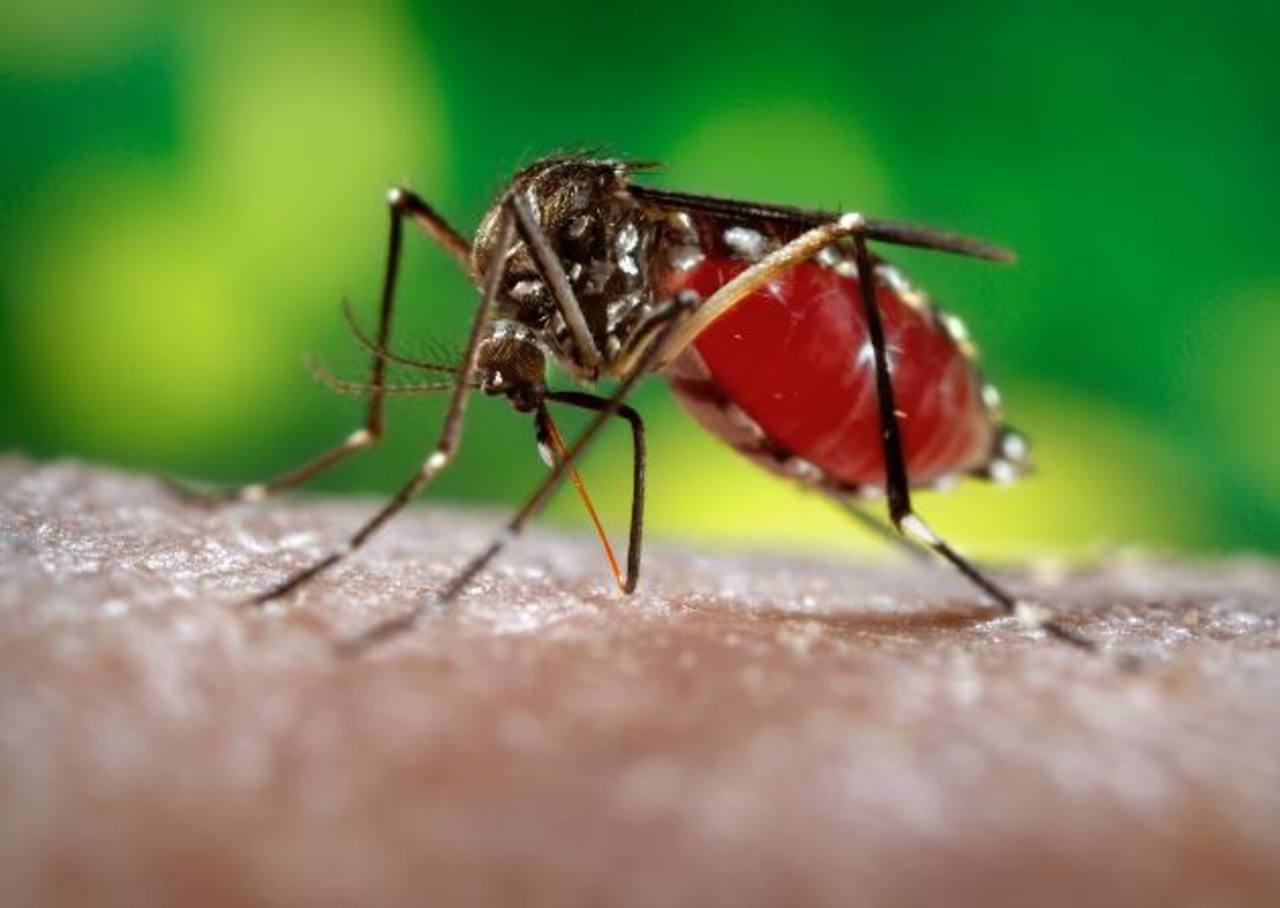
Sube a 16 los fallecidos por dengue este años en República Dominicana

2006 Prof. Frank Hadley Collins, Dir., Cntr. for Global Health and Infectious Diseases, Univ. of Notre Dame This 2006 photograph depicted a female Aedes aegypti mosquito while she was in the process of acquiring a blood meal from her human host, who in this instance, was actually the biomedical photographer, James Gathany, here at the Centers for Disease Control. You’ll note the feeding apparatus consisting of a sharp, orange-colored “fascicle”, which while not feeding, is covered in a soft, pliant sheath called the "labellum”, which retracts as the sharp stylets contained within pierce the host's skin surface, as the insect obtains its blood meal. The orange color of the fascicle is due to the red color of the blood as it migrates up the thin, sharp translucent tube. The first reported epidemics of Dengue (DF) and dengue hemorrhagic fever (DHF) occurred in 1779-1780 in Asia, Africa, and North America. The near simultaneous occurrence of outbreaks on three continents indicates that these viruses and their mosquito vector have had a worldwide distribution in the tropics for more than 200 years. During most of this time, DF was considered a mild, nonfatal disease of visitors to the tropics. Generally, there were long intervals (10-40 years) between major epidemics, mainly because the introduction of a new serotype in a susceptible population occurred only if viruses and their mosquito vector, primarily the Aedes aegypti mosquito, could survive the slow transport between population centers by sailing vessels.

Santo Domingo, Rep. Dom.-Tres nuevas muertes por dengue en pacientes menores de edad, elevan el total de defunciones a 16 en lo que va de año, informó el Ministerio de Salud Pública, mientras que, los casos sospechosos han aumentado a 15,606.

Durante la semana epidemiológica 42, se registraron 1,175 pacientes febriles con posible dengue, cifra inferior a semanas anteriores.

Según el titular de la Dirección General de Epidemiología, es esencial buscar asistencia médica desde el primer día de fiebre, ya que el 56% de los casos llegan tarde, con fiebre entre tres y cinco días.

Actualmente, hay 640 pacientes ingresados en camas disponibles en la red pública, con una disponibilidad del 32%.

En la región de la Cero, la demanda es alta, con solo 24 camas disponibles de 332 pacientes internos.

La directora del Hospital Hugo Mendoza destacó que el 70% de los pacientes con dengue no requieren internamiento si se les brinda seguimiento y atención temprana.

Comentarios de Facebook


Descubre más desde Noticias breves

Suscríbete y recibe las últimas entradas en tu correo electrónico.